
While much of the collegiate esports conversation this fall has centered on conference realignments and new game titles, universities have also been making major investments in physical infrastructure.
Across the country, the Fall 2026 semester saw a wave of brand-new builds, massive remodels, and corporate naming deals. Rather than hiding varsity rosters away in isolated computer labs, schools are placing these new spaces directly inside student unions and central campus hubs to welcome casual gamers alongside competitive athletes.
Brand-New Campus Hubs
University of Nebraska–Lincoln
On October 22, the University of Nebraska–Lincoln officially opened the Husker Gaming Center inside the Nebraska Union. The facility replaced old lounge areas with 40 gaming PCs, console stations, three VR setups with omnidirectional treadmills, and a racing simulator.
Director of Esports Ryan Tan designed the space around an unofficial program motto: “Esports is for NE1,” a play on “anyone” that the program even prints on its spare jerseys. While the facility includes a dedicated Varsity Player Lounge in the corner for focused scrimmages, it remains integrated into the main floor so varsity players “constantly brush shoulders with the communities that rally around their titles.”
Since opening, the visibility of the union location has paid off immediately. Within weeks of cutting the ribbon, UNL hosted a campus-wide Halloween hangout and prepared to host the Meridian Collegiate Conference LAN, drawing competing teams from as far away as Pennsylvania.
“We’ve been a slow burn program for several years now, but it’s finally time for us to blaze the trail ahead for esports in Nebraska,” Tan said.
Missouri S&T
According to the Missouri S&T Campus Master Plan, the 8,630-square-foot facility houses 36 general-use gaming PCs, a dedicated competitive arena with 15 competition-spec PCs, and six mobile console carts (two each for PlayStation 5, Xbox, and Nintendo Switch).
Alongside digital gaming, the lounge includes billiards tables, ping pong, a checkout library of tabletop games like Dungeons & Dragons and chess, booth and soft study seating, and a full content-creation studio with livestream capabilities.
Former Esports Club President Josh Perkins noted in Missouri S&T’s eConnection that the venue was built specifically to “provide a place for students and friends to get out of the residential halls, hang out, have a good time and connect in the heart of campus”
Stony Brook University
On the East Coast, Stony Brook University is also expanding its physical footprint. Alongside active open-play hours at its current Tabler Esports Facility, the school has been moving forward this fall with construction on the upcoming DeVries Esports Facility to support its growing competitive rosters.
While Stony Brook has not publicly disclosed exact square footage or final PC counts yet, updates from Stony Brook Esports on X confirm that construction inside the Alan S. deVries Center kicked into high gear in late September and early November 2026. Crews have already wrapped up major electrical cabling, lighting, and carpeting as they prepare to move equipment in.
The expansion comes during a massive growth semester for the Seawolves, who officially joined the NECC for the 2026–27 season and fielded varsity rosters across Valorant, Rocket League, Overwatch, League of Legends, and Super Smash Bros. Ultimate.
Note that while exact hardware counts and an official ribbon-cutting date remain under wraps, the rapid buildout inside the deVries Center marks a major upgrade from their existing Tabler Arts Center space to keep pace with their expanding varsity lineup.

Major Expansions and Remodels
Radford University
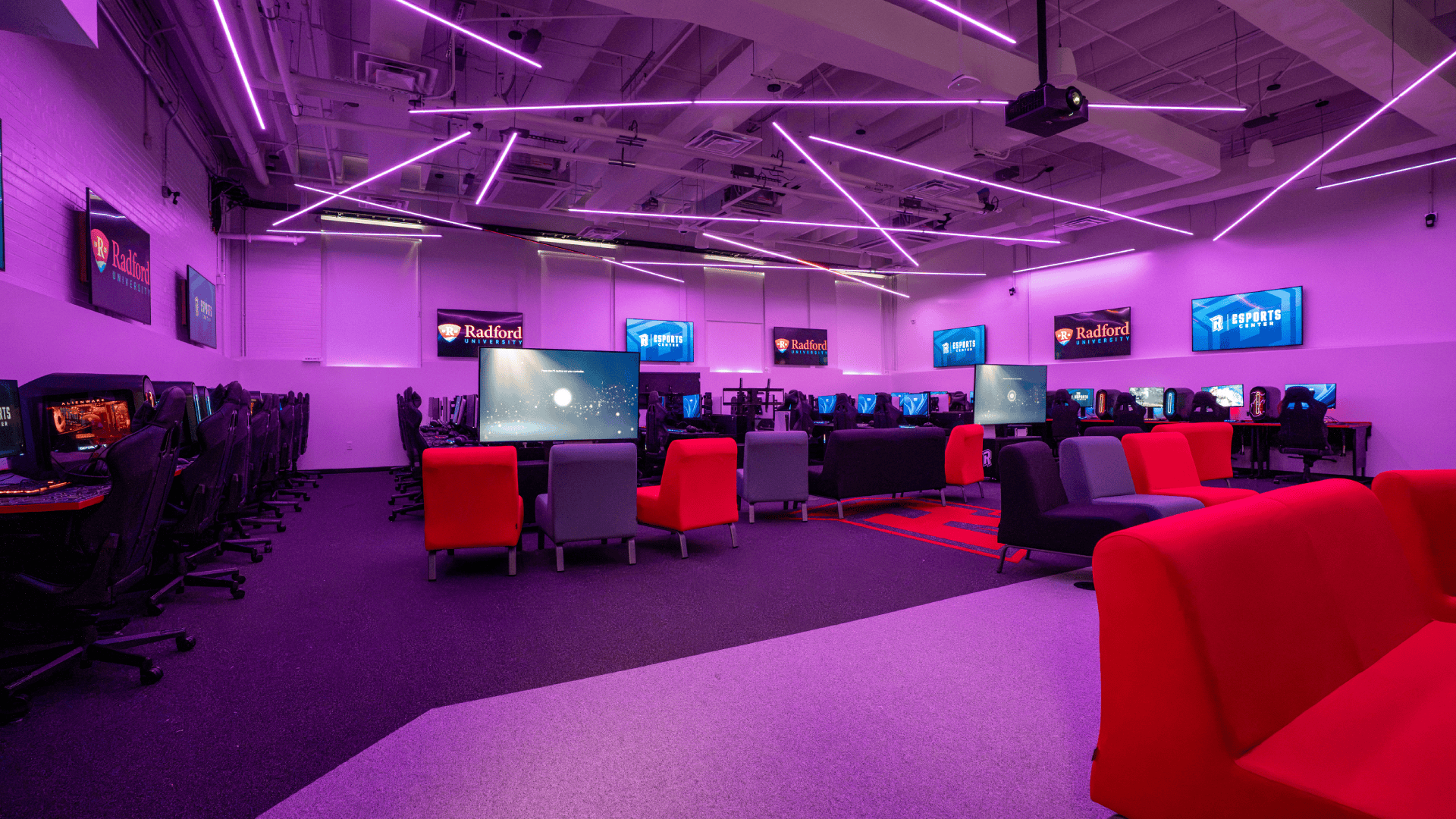
On October 23, Radford University cut the ribbon on a $1.2 million, 10,000-square-foot expansion in Peters Hall. The project quadrupled the school’s previous capacity, jumping from 40 to 80 gaming PCs alongside new team rooms, a media production studio, and a competition stage.
According to Associate Director of Esports Doug Benedict, catering to casual students was the main reason the expansion happened in the first place. After opening a 1,600-square-foot room in 2022, Radford ran out of space in less than a semester.
“The number of students interested has pushed our priorities forward more than any other metric,” Benedict said. “We will always advocate for esports at the college level to be accessible to all students, not just the most competitive players.”
Since allowing students into the renovated space in August, over 1,200 unique students have already used the facility. Benedict noted that the upgrade has also flipped the script on event hosting, bringing in so much interest from outside collegiate and non-collegiate organizations that Radford now has to turn groups away.
Columbus State University
Earlier in the semester, Columbus State University reopened its renovated Davidson Student Center on August 11 following a $4.8 million modernization project. The overhaul gave the university’s esports program a significantly larger, updated home right at the center of campus life.
Per the Columbus Ledger-Enquirer, the $4.8 million state-funded overhaul modernized the 1963 student center, expanding the esports center to more than double the size of its previous room. The broader renovation also added floor-to-ceiling windows overlooking Whitley Clock Tower, new student organization offices, four conference rooms, and expanded study nooks.
At the August 11 grand reopening (which drew over 300 students and community members) Columbus State President Stuart Rayfield called the project “a huge, huge milestone for us to be able to renovate this space so that it does meet our modern needs,” adding that it reflects “the light and the engagement that we want to see on our campus”

s
Corporate Naming Rights and Sponsorships
Dakota State University
Other programs turned to private business partnerships to fund their fall upgrades. On October 31, Dakota State University held a ribbon-cutting ceremony to officially rename its venue the Thermo Bond Solutions Esports Arena. Beyond putting a corporate name on the wall, the partnership directly funds new student scholarships for Trojan esports athletes.
Idaho State University
Similarly, Idaho State University unveiled its Direct Communications Esports Arena inside the Pond Student Union on September 29. Funded by a $520,000 gift from Direct Communications, the venue features a competition stage, audience seating, broadcast capabilities, and roughly 40 setups, with plans to expand into casual open-play hours for the general student body next year.
According to the Idaho State Journal, the $520,000 arena on the second floor of the Pond Student Union replaced a modest first-floor arcade space. It houses 43 custom-built gaming PCs (valued at $3,000 to $4,000 each), a dedicated varsity competition stage, audience seating, a live Twitch broadcast setup, and a casual console zone with Nintendo Switch and Xbox stations.
Now in its third year following a Big Sky Rocket League championship, ISU has already submitted a bid to host the upcoming Big Sky Championship in the venue. Head Coach Charles Johnston told Local News 8 that upgrading their hardware immediately levels the playing field: “Unfortunately, esports sometimes means a team is at a disadvantage if they have worse equipment, so this brand new equipment makes us more competitive.”

Looking Ahead
Whether funded through student union renovations or corporate sponsors, the Fall 2026 semester shows a clear shift in how universities view gaming spaces. By building open, accessible hubs rather than closed-off varsity practice rooms, schools are using eSports facilities to recruit new students, host regional tournaments, and build lasting campus communities.