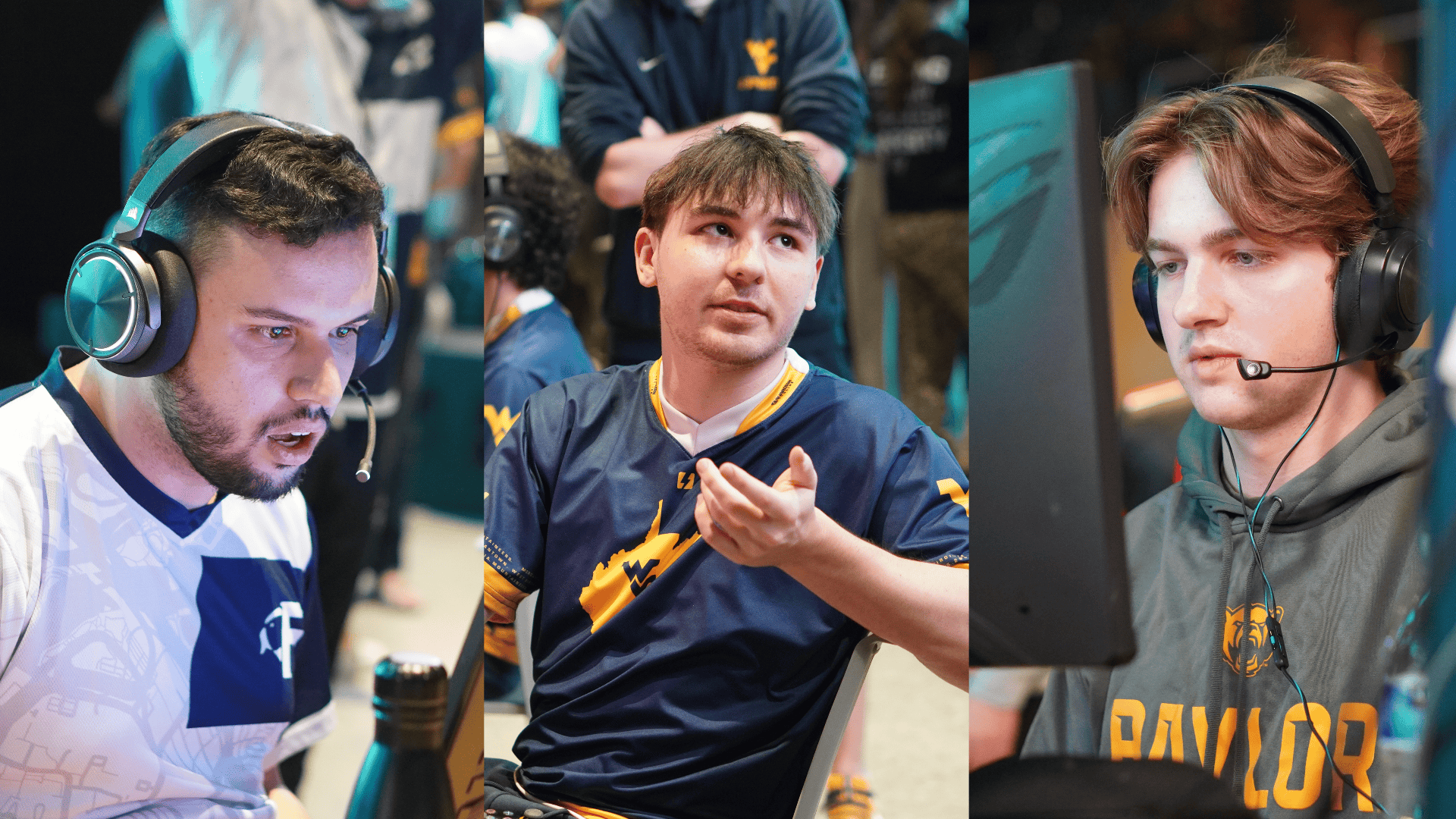
When people talk about collegiate esports, the conversation usually starts with the players. We talk about the teams, the tournaments and the championships. But there’s a lot more that goes into running an esports program than what happens in a match.
Someone has to make the graphics, manage the social media, produce the broadcasts, and give people a reason to pay attention. For collegiate esports creatives, that’s only one part of the job. They’re also helping promote matches, highlight players, and keep their communities connected… work that can be easily overlooked when the final product is all the public sees.
AI has made it easier than ever to generate an image, but creating graphics for collegiate esports programs is about more than just producing something that looks good. As AI tools become more common, it’s worth asking what happens when schools start treating creative work as something that can be automated instead of an opportunity for students to learn and contribute.

Kyle Vest, a graduate assistant with Utah Esports sees media coverage as a necessary part of collegiate competition. He recalled a lesson from his undergraduate years: if nobody is there to watch, what is the point of having esports?
“Realistically, a lot of collegiate esports programs are mediocre,” said Vest. “Not the case for every school, but you’re not watching because they’re the best players ever, you’re watching them because they’re representing your school.”
Yes, competition gives people something to play for, but the content helps other people discover those teams, follow their progress, and actually care about what happens next.
For Mike Decesare, Winthrop Esports’ social media manager, content is about more than promoting upcoming matches. It also helps connect students across the program. A player on one team might not know what’s happening with another, and the work of a content team can help bridge that gap.
“Brands are like a bank, you can keep putting money into the bank and that’s investing in your brand,” said Decesare, quoting Steve Jobs, “There’s so many different things that social media can do. It makes you look premium if you go the extra mile. It makes students feel special.”

Creative work also gives a program a presence outside of its own competitive scene.
Good content can introduce a team to people who don’t follow its game, show prospective students what the program has to offer, and give current students something to rally around.
Roceo Sy, a student graphic designer for Fresno State Esports, shared a similar perspective. To her, visibility matters and creative teams can engage current and incoming students, bring attention to the program and help people see that there’s a place for them in collegiate esports.
“Without the media team, Fresno State Esports wouldn’t even exist.” Sy shared. “At least, not as the FSES we know today. Without the students behind it, we wouldn’t have the same presence or opportunities to showcase what Fresno State Esports has to offer.”
Every program does media differently
Not every collegiate esports program has the same resources, and the way schools organize their creative work can look very distinct.
Missouri Southern
At Missouri Southern State University, Gerardo Martinez works as the social media coordinator for the esports program. He handles the program’s social media accounts and creates its graphics as a student club member.
As the program has grown, so has the amount of content it needs. Missouri Southern has also received more university attention following championship wins in Mario Kart and Marvel Rivals.
University of Utah
Utah Esports has a substantial broadcast operation, with Vest describing a production team of around 70 people. Its social media operation, on the other hand, is much smaller. Vest handles the social media side mostly himself, while the broadcast team streams five different games each week.
“We were one of the first to start collegiate broadcasting, we have people at Riot Seattle working on VCT and people who went to OWCS,” said Vest, “COVID sort of tore everything apart, and for the first two years I started, we didn’t really do any content. We spent the next two years building up production and content… [and] this is the first year we had that really big boom.”
University of Southern California
USC takes another approach. Marketing director Leila Clinton works closely with the media director and content staff. She emphasized that static graphics and announcements for meetings and events are just as important as longer-form content. USC Esports’ creative work is volunteer-based and operates within a club structure.
Fresno State
Fresno State Esports has its own structure through a group of students called Hype & Ekko. Hype focuses on PR and graphics, while Ekko handles broadcast. The program also has a paid student graphic designer, Sy, whose work is part of its broader creative operation.
Sy shares that FSES functions off a class credit internship structure, giving students room to work independently, experiment, and develop their skills maintaining the program’s brand identity.
Winthrop University
At Winthrop, Decesare described a main content team of four people, with nine students involved overall who either want to help or learn.
The program has also developed a pathway that lets students move from academy-level content opportunities into larger roles. Some positions are scholarship-based, giving students paid opportunities to become involved in esports.
“Some of the skill in collegiate esports, and this is a skill that takes awhile, is just how you navigate red tape. Realizing where there might be blind spots in your university’s policies. Figuring out what they care about, and whether they might care about other things.”
– Mike Decesare, Winthrop Esports
These programs don’t all have the same resources, staffing, or responsibilities. Some have large production operations, while others depend on a smaller group of students to cover several needs. Each example shows that creative work has to fit the program it’s supporting.
Where AI enters the conversation
There are understandable reasons a program might turn to AI. Not every school has the budget, staffing, or student interest needed to maintain a full creative team, and AI tools can make certain tasks easier.
Martinez acknowledged that it depends on the school. Some programs don’t have people available to create graphics, but he doesn’t want his own program to rely on it when he is already there to do that work.
For Martinez, creating graphics is part of his contribution to Missouri Southern. He believes that taking the time to create something reflects the creativity and ambition of the team.
He also questions how audiences might react to a graphic announcing a team win if it were generated by AI instead of created specifically for the program.
“I think AI will be here for a long time,” Martinez said, “It’s a tool to use, but I think it’s a tool that will cost you your image.”
Vest raised similar concerns about the impact of AI on a program’s brand. He believes AI might catch someone’s attention, but that doesn’t necessarily mean it will leave a lasting impression. He also pointed to the risk of making a program’s brand feel cheaper by relying on generated content.
Clinton described AI content as insincere and repetitive, arguing that students understand the social media landscape in ways that make their creative involvement valuable. Students are a part of the same online culture that collegiate esports programs are trying to reach.
Sy warned that AI-generated graphics can feel generic and affect a program’s brand identity over time, “[Relying solely on AI] takes away opportunities for students to gain valuable experience through practice, experimentation, and refinement. Collegiate esports should be about cultivating talent, not replacing the very opportunities that allow students to grow.”

What students lose when creative work disappears
The consequences of replacing student creatives go beyond the appearance of a graphic. Creative roles can also give students a way to get involved in esports, gain experience and discover interests without having to join a game’s team.
Sy described starting out on Fresno State Esports’ creative team before eventually competing as a player and becoming the student leader, who oversees the program and operations.
Decesare had a similar experience at Winthrop. After being removed from the Overwatch team, he moved into social media and video work, where he discovered a new passion.
He said there is often a student at a university who wants to work in esports is willing to put in the effort, but programs have to be willing to give that person an opportunity, “There is usually always a student that goes to every university that is lightning in a bottle, whether that be production, casting, graphic design, or social media. Not casting your line is the worst thing you can do.”
Winthrop’s content pipeline offers one way to do that. Students can develop their skills and gain experience before moving into larger roles. For a student interested in graphic design, production, casting, or social media, that kind of structure can provide a starting point for a career in the industry.
Removing those opportunities in favor of AI could mean losing more than the person responsible for making a graphic. It could mean losing an outlet for students to practice, build their portfolios, and find a career direction.
“A lot of what I like about collegiate, it feels a bit underdog-y,” said Vest, “You try to make the most of what you have and it feels really good when you have a good piece of content.”
Investing in the people behind the program
Collegiate esports programs don’t need identical creative departments to recognize the value of student involvement. A smaller school may not be able to support a large team, and not every program has the same budget.
But investing in creative work doesn’t have to mean building an entire department. It can start by identifying students who want to contribute, giving them clear responsibilities, and allowing them to develop those skills.
“Esports shouldn’t be a thing the school is pouring money into for no reason.” said Decesare, “If you don’t have that sort of bridge onto the campus community, it’s the end of it.”
The programs interviewed here offer different examples of how that can look. Missouri Southern has a dedicated student social media coordinator. Utah has a large broadcast operation alongside a small social media team. Winthrop has a pathway for students to develop their content skills, while USC operates through a volunteer based club structure. Fresno State teams divide responsibilities through different teams and internship opportunities.
There isn’t one model every university has to follow. But these examples show that creative work can be structured in ways that give students opportunities to learn and contribute, regardless of the size of the program.
AI isn’t going away, but producing content quickly shouldn’t be the only goal. Programs also have to consider the students who want to learn, the identity they’re building, and the community they’re trying to reach.
Cora Kennedy of University of Oregon Esports recently published a document on AI image generation in collegiate esports, saying, “All that you need to do is start somewhere. Talk with your students and find out what they would like to see… It’s not a permanent stain on your record or even some unforgivable sin to have “do better” uttered about your work. It’s an opportunity to find the next path forward that you can be proud of.”
Collegiate esports gives students opportunities to compete at the university level, but it can also give them opportunities to create, produce, promote, and explore careers in the industry. It’s up to the people behind the program to prioritize student experiences and help make those opportunities possible.