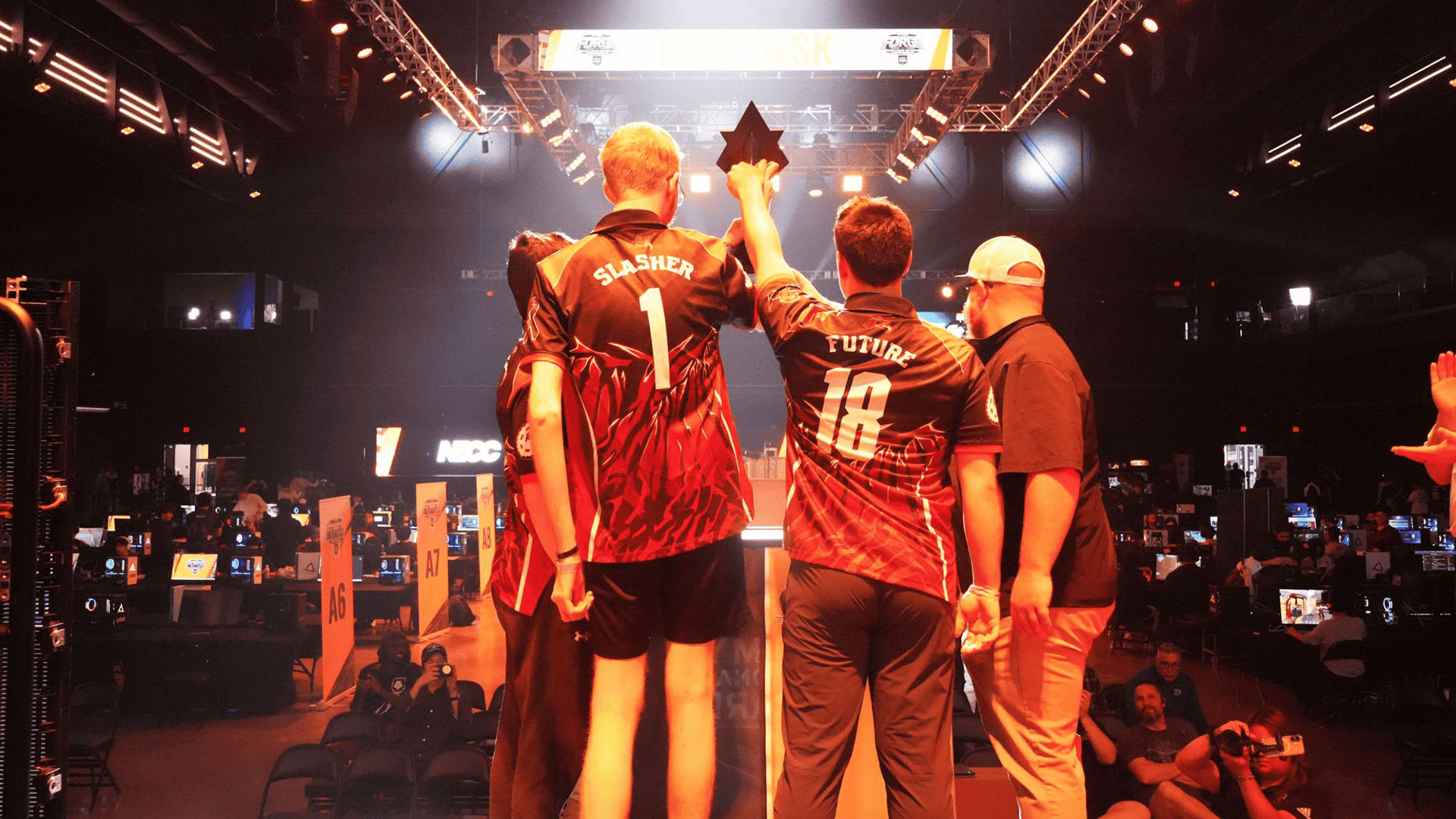
The NACE Grand Finals delivered another memorable weekend of collegiate esports competition, bringing together the best programs in the country for a showcase of talent, production, and community.
The event took place at Full Sail University in Orlando, Florida, from April 23-26, 2026, and held over 40 teams competing throughout the entire weekend. The live broadcast generated over 100k concurrent viewers, and over 50 Full Sail students served in event support roles throughout the weekend.
New This Year
This year’s Grand Finals represented a significant step up from 2025. NACE Executive Director Riley Long reflected on the growth NACE has seen over the past few years:
“In 2025, we moved our Spring Grand Finals from 12 to 48 teams: Top 2 to Top 8 per game title. It was a prove it year, and we delivered, but highlighted some key areas of improvement for 2026.”
This year, NACE addressed those areas head-on. Long pointed to upgraded equipment, increased stream coverage of the Top 8 stage through the school partner program, a new media staff room, and the integration of the first official Overwatch Collegiate LAN since 2019 as the headline improvements. The Overwatch broadcast alone peaked at 150,000 concurrent viewers.
“We are ecstatic of the reach that the NACE Grand Finals accomplished this year,” Long said, “and the improved experience for all of the programs and students at the event.”

Looking ahead, Long sees the Grand Finals continuing to grow into something bigger than just a tournament: “Five years from now, I expect the NACE Grand Finals to evolve into a holistic celebration of varsity esports, serving as the premier competition experience in college esports, with further publisher involvement and more activations for fans to engage with.”
A Stage for Students On and Off the Screen
The Grand Finals also served as a live classroom for over 50 Full Sail University Students, who served in a variety of roles, including game technicians, audio assistants, lighting operators, EVS operators, jib and robotic camera operators, observers, stage managers, casters, roaming reporters, and more.

Jacob Kaplan, Director of Esports Business Strategy at Full Sail University, spoke to what that experience means for the students and next generation of industry professionals:
“These are some of the roles that our students filled throughout the NACE Grand Finals,” he said, listing everything from teleprompter operators to engineering assistants. Around 50 students contributed to the event’s production, a number that reflects Full Sail’s continued commitment to treating major esports events as hands-on career development opportunities.

The student presence extended onto the broadcast from non-Full Sail students as well. Cody Rooke, an esports student from the University of North Florida, landed a pre-match interview opportunity through College Esports News during the Overwatch Open’s Grand Finals:
“I thought it was really cool to be able to interact with some of the players that I’ve been watching for most of my childhood into my adulthood,” Rooke said. “It was really cool to see myself on the main broadcast, and I was able to reconnect with a few people because of it.”
Publisher Partnerships and the Bigger Picture
One of the more notable new additions at this year’s Grand Finals was the partnership with Blizzard Entertainment, marking the first time Blizzard has worked with Full Sail on an event since 2019. The collaboration introduced the Overwatch Open, a non-NACE tournament running alongside the traditional varsity competition.

Riley Long spoke to what this partnership means, and why separating the Open and Varsity divisions was intentional.
“Combining Club, Recreational, and Varsity teams into the same division has historically created sub-par experiences – Club programs competing against schools with significantly more resources, and Varsity teams having mixed experiences competing against Club programs that may lack organizational oversight.”
Blizzard’s involvement addresses that gap directly, carving out a dedicated experience for varsity-level programs. “This partnership represents a key milestone in our industry as we work towards clarifying the different levels of engagement and involvement in the competition realm of college esports. We see this relationship with Blizzard as a key blueprint for how we can provide value for publishers for our other Varsity titles,” Long mentioned.
Sari Kitelyn, Director of Esports and Project Development at Full Sail University spoke on the significance of publisher involvement from the production side and how that feeds into the greater esports industry.
“Publishers and collegiate esports need each other, and I think the best partnerships make that obvious without either side having to say it out loud,” she said. “When Blizzard came to Full Sail for the Hearthstone Collegiate Championship in 2019, what they found was a program that treated their game with the same seriousness they did. A real production, a real stage, real stakes for the students competing. That standard hasn’t changed.”

Kitelyn pointed to this year’s Grand Finals as proof of that continued commitment: “The publishers who have shown up in this space have seen what happens when you invest in a scene that’s already doing the work. The audience is engaged, the competitors are hungry, and the production holds up. That’s intentional. Collegiate programs have spent years building infrastructure that publishers can walk into and trust.”
Kitelyn’s message to publishers on the fence was straightforward: “The programs are here. The students are here. The production value is here. Publishers who understand their own long-term ecosystem already know that collegiate is where that ecosystem gets built.”

Scores/Results
- Rocket League:
- Ball State had a 4-2 victory against Fisher Esports in the Grand Finals. Fisher first defeated Ball State in a clean 3-0 to advance to Grand Finals through the winner’s side of the bracket, while Ball State fought hard with a close 3-2 victory against Baylor to reach Grand Finals through the lower bracket. Ball State was definitely the underdog in the competition, beating out both of CEN’s caster predictions.
- League of Legends:
- Maryville League of Legends asserted their status as one of the most dominant collegiate league teams. Although Maryville was strongly favored to win by CEN casters, Winthrop took a surprising Map 2 off their hands.
- VALORANT:
- Maryville University defeated West Virginia University Esports 2-1 in the VALORANT Grand Finals, with incredibly close maps 1 and 2.
- Overwatch Open + Varsity
- This semester marked the first semester with a new Overwatch Open champion, following the disbandment of Illinois State’s team. Winthrop University beat Northwood University 4-3 in an intense showdown for the Overwatch Open title. Afterwards, Winthrop won 4-1 over the St. Clair Saints for the Overwatch Varsity Title.
- Call Of Duty:
- St. Clair College continued their 5-time NACE National Championship Dynasty in a dominant 4-0 victory over Cumberland University. Rodrigo “Ruper” Armendariz won Match MVP and NACE Call of Duty Player of the Year.
- Super Smash Bros Ultimate:
- Winthrop Esports landed a 2-0 Victory over UTA Esports in an incredibly close matches. UTA Esports also had a dominant semi-finals run leading up to grands.

NACE Player of the Year and Coach of the Year Awards
Rocket League:
- Player of the Year: Matt “Matter” Ehresman (West Virginia University)
- Coach of the Year: Yusef “Thermalrex” Naebkhil (St. Clair Saints)
League of Legends:
- Player of the Year: David “Mobility” Rigley (Winthrop University)
- Coach of the Year: Devin “Kolthro” Drzewuki (Grand View Esports)
Call of Duty:
- Player of the Year: Rodrigo “Ruper” Amerndariz (St. Clair Saints)
- Coach of the Year: Evan “Bostonstats” Gouveia (Cumberland University)
Overwatch:
- Player of the Year: Alex “Tred” Madgwick-Smith (St. Clair Saints)
- Coach of the Year: Eric “Wheats” Perez (Winthrop University)
Smash:
- Player of the Year: Chris “Quidd” Rella (Stony Brook University)
- Coach of the Year: Brandon “Zaxxor” Hackett (LCU Esports)
VALORANT:
- Player of the Year: Phillip “Infiltrator” Nguyen (Winthrop University)
- Coach of the Year: Austin “Legend” Lee (Kennesaw State University)
Conclusion
Winthrop University ultimately came out as the most winning-est program of the weekend, taking home 3 trophies for Overwatch Varsity, Open and Smash, followed by Maryville with two different title wins in League of Legends and VALORANT. Ball State Esports came out as a breakthrough team for NACE, winning their very first NACE Championship title in Rocket League, and St. Clair continued their legacy as Call of Duty Champions.