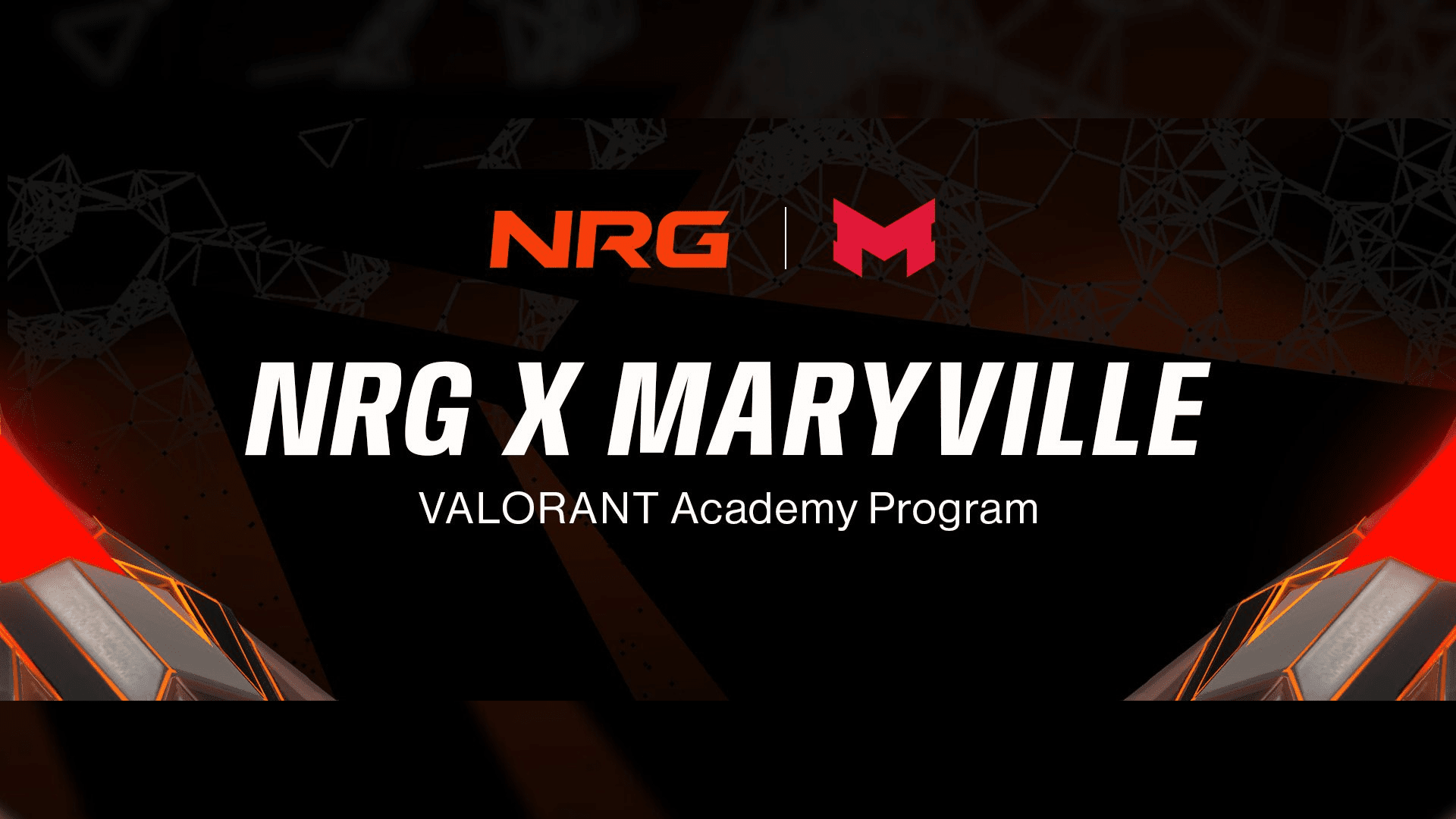

Maryville University’s VALORANT Team has partnered with NRG to become “NRG Academy” for VALORANT Challengers League (VCL), Riot’s official Tier 2 tournament circuit.

NRG announces NRG Academy (VALORANT)
On January 13, 2026, NRG published a press release on X, announcing a new partnership between Maryville University VALORANT and NRG Esports:
NRG is launching NRG Academy (VALORANT), a new development program built to train the next generation of elite talent in North America while competing in the VCL.
As reigning champions, we at NRG believe that winning at the highest level comes with a responsibility: committing to the next generation by creating real pathways for players who want to chase the same dream. In service of that mission, NRG Academy is designed to support long-term player growth through a pro-standard training environment, internal development opportunities, and meaningful competition.
Through this partnership, both parties aim to create a structure that supports competition, training, and education, where eligible players can pursue a degree while developing as a high-performance player.
This can help alleviate a difficult decision some young esports players make: whether or not to pursue an education versus risk a career in esports. Players joining NRG Academy have the option to attend Maryville and compete on their VALORANT teams, subject to eligibility and admissions.
NRG Academy’s starting roster for VALORANT Challengers in January 19, 2026:
- Adam “Ange” Milian
- Caide “chloric” Heaton
- Tanner “geeza” McGhee
- Austin “RENZ” Dickman
- Yahya “shondex” Amani
- Coach – Matthew “mCe” Elmore

Yahya “shondex” Amani is the most recent addition, joining on January 6th. All roster members are with Maryville University as students and still under their university’s banner outside of VCL.
For those unfamiliar: A brief history of NRG
NRG is an American esports organization based in Los Angeles founded in 2015, with rosters in Overwatch, Rocket League, CS2, and VALORANT. Their VCT (Valorant Champions Tour) Team won 2025 VALORANT Champions, the professional-tier world championship for VALORANT, and went up for an “Esports Team of the Year” nomination at the Esports Awards.
This partnership with two of the most recognizable names in their respective spaces (NRG in the professional space and Maryville in the collegiate space) is a ground-breaking achievement for the collegiate-professional pipeline, and proves what many people in this space have been saying for so long: collegiate is the future of Tier 2 esports.

Copyright: Colin Young-Wolff)
NRG was also recently acquired by DarkZero Esports, which rebranded all of its teams to the NRG branding. Maryville’s League of Legends team was partnered with DarkZero while competing in the League of Legends North American Challengers League (NACL) in 2025, which is the League of Legends Tier 2 circuit for North America.
Given the acquisition of NRG by DarkZero, it is noticeable that the existing relationship may have paved the path for the NRG Academy team we see today.

What this means and why it’s important
While a collegiate team in Tier 2 is already a monumental feat, if the team has a successful run in VCL, they can be eligible for VCT (VALORANT Champions Tour) Ascension Americas, the final tournament series of the VALORANT Challengers League year. Should the team place first, they could be promoted into VCT for the following year, becoming the first-ever collegiate team to be eligible to compete at the professional level. Team ENVY was the 2025 winner, and just made their VCT debut this past week.
Maryville placed 5th-6th in VALORANT Challengers 2025 last year, despite placing 2nd during the Swiss stage. Although Maryville fell short of VCT Ascension, Winthrop Esports, the other collegiate team in VCL and winners of the VCT Spotlight Series, did qualify to the Ascension matches, and placed 4th overall, an incredible feat for a collegiate team.

So far, NRG Academy has gone 2-0 for VCL, with victories against Alliance Guardians and M80, competing for a prize pool of $38,000 in this league. Winthrop University is also currently playing in VCL, meaning we will be seeing another Maryville vs. Winthrop collegiate showdown in Tier 2 VALORANT this year. Maryville defeated Winthrop 2-0 the last time the two teams faced off in VCL.
Player development is extremely important for the sustainability of esports as a whole. Aspiring professional players who are in the Tier 2 space often juggle work, school, and other life challenges, while typically getting paid much less than their professional counterparts, if at all, while pushing themselves in-game to be eligible to compete at the highest level.
The average age of a VCT player is 22-23 years old, a typical age for a college graduate. The collegiate-professional pathway becomes much clearer with this partnership – high school graduates can go to one of these colleges on a scholarship, with a priority focus on their education and development as a professional gamer. Experience in a high-intensity environment while completing a degree is a challenging, yet incredibly rewarding experience professional organizations will heavily consider when building their rosters.
Given that the average length of a professional VALORANT Career is roughly 3-5 years, these players are equipped with a degree and skills necessary to easily transition out of professional play if they wish to, or join their organization in another capacity (such as in marketing, tech, or sales) without navigating going back to school at an older age.
When building a sustainable esports scene, it is important to remember that the core of any esport or game is the player. Giving players opportunities like this, beyond the competitive stage and behind-the-scenes, is incredibly important and meaningful work. Not only does it build loyalty to your game or brand, but it allows your community to unleash its greatest potential, both in and out of the game.