
CSMG recently released a Request for Proposal (RFP) to schools seeking “student workforce” submissions for its 2026 CECC May Madness event. While the promise of on-site experience may be exciting for some, many members of the collegiate esports community have raised concerns over the lack of transparency surrounding compensation, and how dependent the event appears to be on student labor.
Background
A recent post on X from the CECC May Madness event organizer, EsportsU, sparked significant community discussion regarding the value of student labor. In the post, Collegiate Sports Management Group (CSMG), the company behind the EsportsU brand, asked colleges and universities to submit bids to send supervised crews of students to work various roles at the 2026 CECC May Madness event.
On January 30, CSMG published the following tweet, alongside a link to the official RFP document:
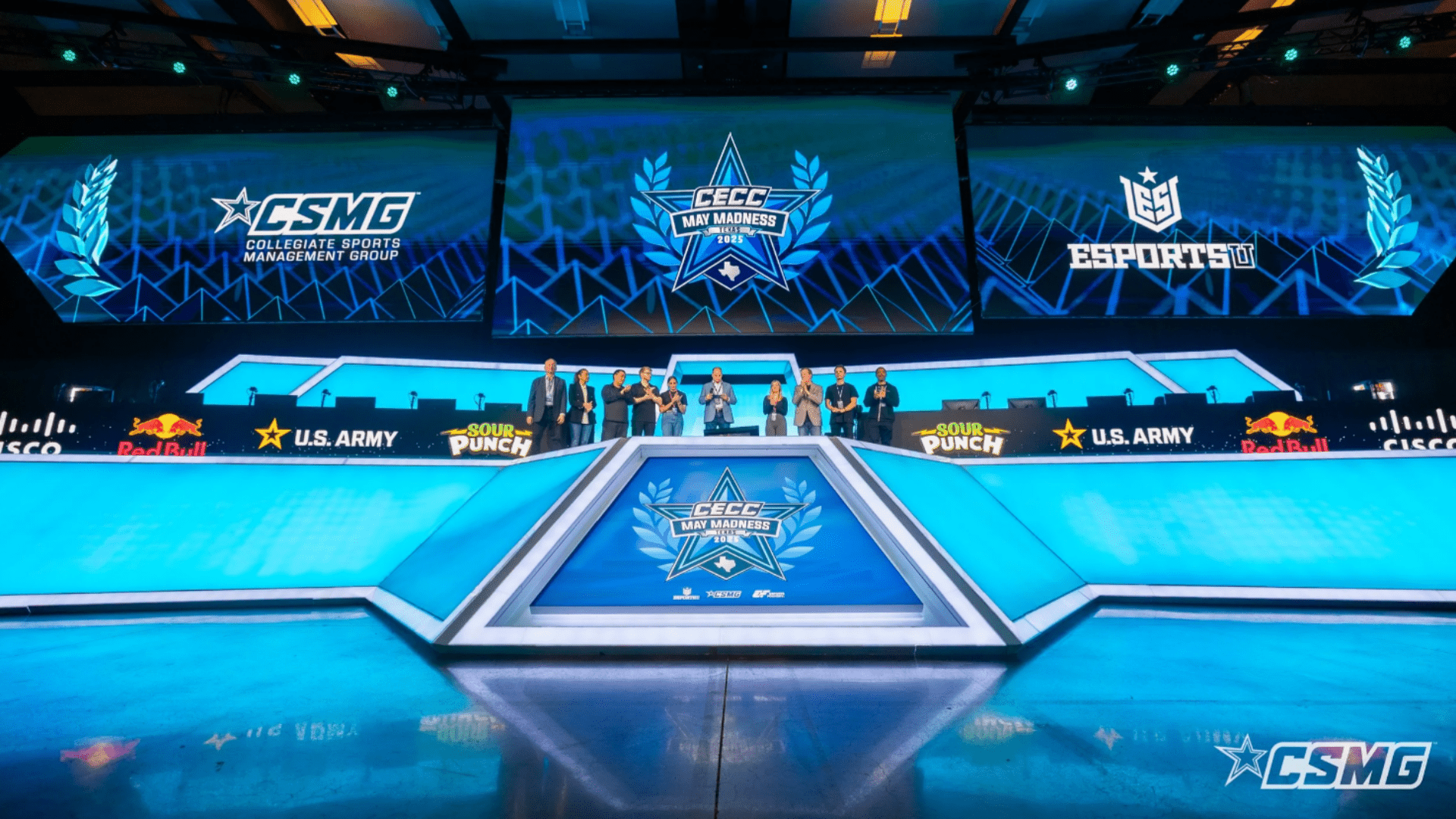
Collegiate Sports Management Group (CSMG) owns and operates the Collegiate Esports Commissioner’s Cup (CECC) “May Madness” which is the largest scholastic multi-game esports LAN event globally.

CECC May Madness has operated for the past five years. In 2025, the event reported over 5,000 live attendees and 5.1 million live views. The tournament hosted multiple collegiate and scholastic esports conferences, including the Texas High School and Middle School State Championship, Playfly, MECC, and Apex Legends. May Madness also featured white-label sponsors such as McDonald’s, the U.S. Army, Alienware, and Red Bull.
The 2026 May Madness event is slated to be in Waco, Texas, from May 1-May 4 at the Waco Convention Center.

The Response
Following the release of the tweet and RFP, many collegiate esports community members voiced concerns about the lack of clarity around compensation. Specifically, the wording “empower students to obtain on-site work experience” raised red flags, as the RFP did not explicitly state whether student workers would be paid or whether travel and lodging costs would be covered.
It is also notable that CECC is not asking students to apply directly. Instead, schools are being asked to submit bids proposing groups of students, along with associated rates, to staff the event.
This is what was outlined in the RFP:
Schools may bid to provide students for one or more role groups listed below. Schools are not required to cover all roles but must clearly identify which groups and positions they are proposing to staff and their rates.
RFP Issued: January 30, 2026
Submission Questions Due: February 13, 2026
Submission Deadline: February 20, 2026
Selected Schools Notified: February 27, 2026
The RFP lists at least 78 unique roles that need to be staffed, including but not limited to:
- Tournament Operator
- Stage Hand
- Operations Assistant
- Logistics Coordinator
- Merch Assistant
- Videographer
- Floor Interviewer
- Desk Analyst
- Caster
- IT Engineer
- Network Engineer
- Producer
- Technical Director
- Gameplay Director
- Observers
It is unknown the full extent of compensation CECC is offering to schools who bid and members of its student workforce, whether that is payment, lodging, or travel.
An announcement shared in the CECC Discord server on Wednesday, February 4th clarified some potential travel considerations for players attending the event:

Distance is also a significant factor. While Baylor University is located in Waco, the city is still 1.5–3 hours away from major Texas metro areas such as Dallas, Austin, and Houston. For many schools, attending May Madness would require arranging additional transportation and lodging.
College Esports News reached out to CSMG regarding the community’s concerns and confusion regarding student workers and compensation for CECC May Madness 2026. CSMG responded with the following statement:
“Please refer to page 4 of the RFS and responders may submit additional questions to Damon Scott, ToniAnn Convertino and Angela Bernhard Thomas by February 13.”
While partnering with schools places logistical responsibility on institutions rather than individuals, this also means that non-local or lower-budget schools will be responsible for covering student travel, lodging, food, and other expenses.
Community Reaction
The tweet sparked a strong reaction within the collegiate esports community, including from individuals concerned with payment issues they’ve had in the past, or about the possibility of replacing paid staff with student volunteers.
Some community members expressed frustration with the vagueness of the RFP. While it does allow schools to submit day rates for their proposed staff, it does not explicitly outline expectations regarding compensation, travel, or lodging.
Some student leaders who have worked this event, or have run similar events, are cautiously optimistic:
“The idea of a “Workforce Partnership” between CSMG and universities around the nation is a terrific concept. If done right, there could be real value when real-world work experience and education are linked with collegiate esports.” said Camilo “Botanic” Chaves-Galeano, Cincinnati Esports Club President.
He continued: “Such an ambitious concept will simply require more communication than an 11-page RFS document. Are the reactions they’ve received so far justified? Absolutely. Should we all be hopping on our own passenger cars aboard the “CECC is over train”? No. I think we should continue to apply steady pressure on CSMG to be more transparent about their vision for the Workforce Partnership and how it changes the established hiring chain.”

TJ “DJTJ” Stephens, a collegiate Rocket League caster and former UGA President, also weighed in:
“As somebody who has worked as and with student workers for their entire career, we are used to being undervalued and underpaid heavily. But for an event like this, there is absolutely no exception and no reason why the biggest event in collegiate Esports is not paying staff.”
He Added, “This is a checkpoint in our scene if an event as big as this doesn’t have their priorities straight enough or doesn’t have their finances straight enough to pay workers or student workers. Currently, there is absolutely no incentive or want for a college student to have to work this event unless they are within driving range and/or are getting paid fairly.”
An anonymous source who runs major collegiate esports events also offered a different perspective:
“First: it’s clear a lot of people have residual anger and negativity towards CSMG from last events’ payment issues. Second: I read the RFP and they aren’t asking for free labor in my opinion. Section 4 makes a mention of schools to outline roles, students, and rates. I’m assuming they’re hoping some schools would potentially provide volunteers by not being extremely explicit, but this reads fairly standard as far as RFPs go.”
The Larger Issue
Collegiate Esports, and esports in general, has always struggled when it comes to profitability and sustainable wages. Likewise, many in this industry have struggled when it comes to receiving competitive wages, and for students, the promise of “experience” in exchange for receiving little to no pay is all too familiar.
Additionally, it is important to recognize that an event like May Madness is expensive and takes a village to run. Given the location, technical requirements, and space requirements, this event will easily burn through a hefty budget, even on a skeleton crew. There is an argument to be made in support of CSMG’s side:

From a tournament operations perspective, outsourcing certain roles to students may be a financially responsible decision, especially if students are already local and willing to volunteer. Additionally, for schools already attending/playing in CECC May Madness, it may not hurt financially to send additional hands to an event they are already attending. It is also possible some student workers can get an internship or coursework credit.
On another hand, this is a major commercial, non-charity, for-profit event with white-label sponsors. Although the opportunity of experience will be extremely valuable for any student working this event, for an event this large, it is fair to be critical regarding the lack of clarity around compensation, and not being upfront about covering travel, lodging, and other expenses for workers. Additionally, the apparent absence of paid, non-student roles sends a troubling message about long-term career viability in esports.
In an industry where it is common to be unpaid, underpaid, or not paid on time, it is up to larger entities in the space to set an acceptable standard for compensation and transparency, especially for those who currently work – and aspire to work – in esports as a career.